You're Not Bad at This — You're Just Early
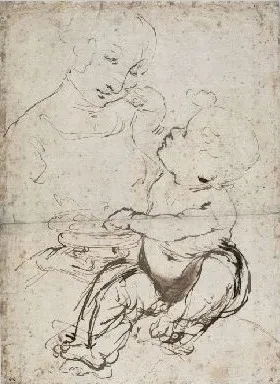
Photo: Leonardo da Vinci, Public domain, via Wikimedia Commons
You know the feeling. You open the file, spend four hours on something, lean back, and immediately want to close the laptop. Not because it's broken, exactly. Because you can see what it should have been, and this isn't that.
That experience has a name in creative circles, popularized by a well-known talk from a couple of decades back: the gap. Your taste develops faster than your ability to execute. You can recognize good work long before you can make it.
It's the most common reason people quit. It's also, quietly, evidence that something is going right.
Why the Gap Opens
Here's the part that makes it sting: taste gets built for free. You absorb it every time you look closely at something well-made — a film, a poster, a chair, a book jacket. Judgment develops passively, just by paying attention.
Skill doesn't work that way. Skill requires reps, and reps are slow, and the reps don't feel like progress while you're doing them. For a while they just feel like more bad versions of the thing you already knew should be better.
So you end up with a highly trained eye and hands that haven't caught up yet. The eye files a complaint. It's correct and useless at the same time.
There's also a version of this nobody warns you about, where the gap opens again after you've been working a while. You learn enough to see a whole new layer you didn't know existed — better composition, better typography, better structure — and suddenly the work you were proud of last year looks thin. Same mechanism, different decade. It never stops happening. It just stops being an emergency.
Two Ways People Respond
When the gap shows up, most people pick one of two doors.
Door one: quit. Or drift. Or keep making things while telling yourself you're not really a designer, not really a writer, not really an artist — a hedge against being judged on work you already suspect is beneath you. This is the most common outcome, and it has nothing to do with talent.
Door two: protect the ego. Post less. Avoid critique. Stay in the territory you can already execute, because that territory doesn't produce the bad feeling. It also doesn't produce growth. Plenty of people coast here for a decade and call it a style.
There's a third door, and it's less dramatic than it sounds. You accept that the uncomfortable feeling is the sound of working at the edge of your ability, and you build a practice that closes the gap faster than your taste runs ahead of it.
Closing It: Practice That Actually Counts
Not all practice closes the gap. Time spent repeating what you can already do mostly maintains. What moves the needle is deliberate work — slightly too hard, closely examined, adjusted on the next attempt.
Copy things on purpose. Not to steal, to learn. Rebuild a layout you admire from scratch and figure out why the original decisions work. Do the same exercise three times with different constraints. You're not producing a portfolio piece. You're downloading someone else's instincts.
Name the problem before you fix it. Vague dissatisfaction — this looks wrong — is where most people get stuck. Force it into specificity: the hierarchy doesn't hold, the spacing is inconsistent, the third paragraph is doing two jobs. A problem with a name can be solved. A problem that's just a mood cannot.
Get critique with constraints. General feedback from friends is worth about as much as it costs. Ask for targeted critique from someone one or two steps ahead of you — not ten steps, or you'll get advice built for a skillset you don't have yet. Ask what they'd change and why. Then apply exactly one thing per revision and see what happens.
Volume, then review. Make more things than you'd prefer to, badly, on purpose. Then — this is the part everyone skips — go back through the pile once a month and mark what improved. New skill is invisible from the inside. It only becomes visible on the way back.
Frustration Is Feedback
The frustration that comes with the gap gets misread as evidence. It feels like I'm not cut out for this, when the more accurate translation is my standards are functioning.
People who don't care about the work don't get frustrated by it. They make something mediocre and move on with their afternoon. The fact that you can see the distance between your work and your aspirations means the aspirations are alive and doing their job.
That doesn't make it pleasant. But it does mean the feeling is information, not a verdict. Use it as a map: the thing you're most annoyed about in your own work is usually the next thing worth learning.
The Gap Never Closes — It Moves
Here's the honest ending. The gap doesn't shut. It relocates.
You get better, your taste gets sharper, and they meet somewhere new and further out. The work stops being bad in the old ways and starts being bad in unfamiliar ones. What changes is your relationship to that experience. What used to feel like proof of your inadequacy starts to feel like the normal weather of making things.
So if you're in the middle of it right now and your eyes are writing checks your hands can't cash — good. Keep the hands busy. They'll get there, and they'll take longer than you want, and that's the entire path.